River Health Assessments are generally not stand alone efforts. They are characteristically performed to evaluate ecological and physical conditions to facilitate management of the river that sustains both human uses and ecological integrity. Although developing goals, objectives, priorities, strategies, processes, or actions to manage rivers goes beyond the bounds of the assessment itself, river health information should play a foundational role in identifying and prioritizing potential future management actions or management policies. CoRHAF may be a beneficial component of numerous planning activities that occur throughout Colorado at a variety of scales. These include, but are not limited to:
Source Water Protection Plans
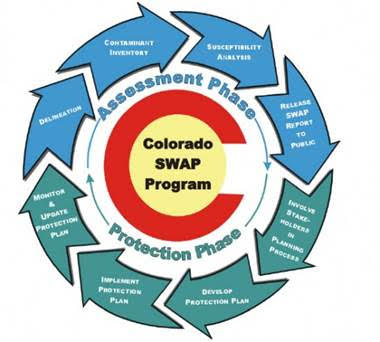
Colorado’s Source Water Assessment and Protection (SWAP) program was created through the 1996 Safe Drinking Water Act Amendments. The program is designed to assist Public Water Systems in understanding the risks and threats to their drinking water quality and water supplies, as well as developing actionable plans and partnerships to address water resource challenges. Click here to learn more.
Stream Management Plans
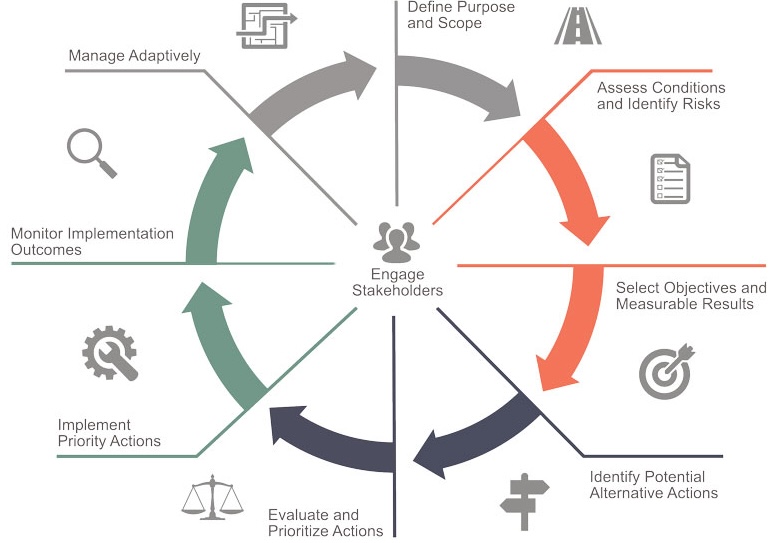
The first Colorado Water Plan included a goal for implementation of Stream Management Plans (SMPs) on 80% of locally prioritized rivers by 2030. SMPs were envisioned as a stakeholder driven and data supported process to identify non-consumptive water use needs (i.e. river health and recreation) and develop feasible strategies for meeting those needs. Click here to learn more.
Wildfire Ready Action Plans
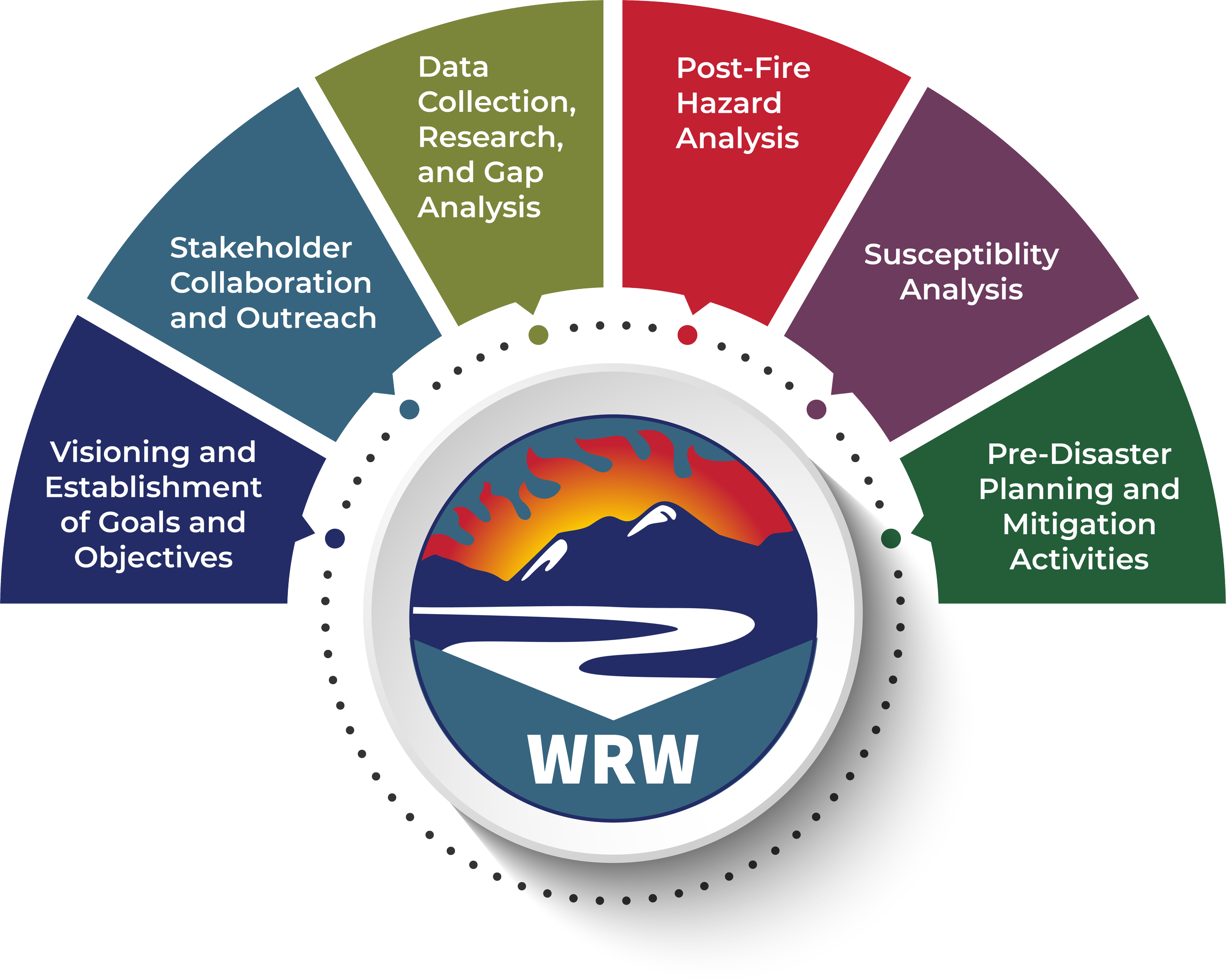
The Wildfire Ready Watersheds program seeks to provide high-level guidance for helping communities predict how post-fire impacts will affect downstream assets. Importantly, this program also aims to identify actions that may be taken to reduce the impact of wildfires on infrastructure and natural resources – both before, and after, a wildfire occurs. The Wildfire Ready Action Plan (WRAP) framework describes and provides guidance on how to refine the susceptibility evaluations for local communities. The WRAP framework is meant to serve as a guide for best planning practices in advance of a wildfire and will also support post-fire mitigation strategies. Click here to learn more.
Assembling river health information into the CoRHAF structure can help stakeholders arrive at a common understanding of the issues and locations that may be constraining river health to the greatest degree. Intersecting geographic information, such as property ownership, with river health information can be used to identify potential projects with a low barrier to entry. Stakeholders and technical teams use their RHAF to anticipate and frame the river health outcomes of any given project or proposed management action.
Target Causes Not Symptoms
Well-meaning stakeholders may attempt to address symptoms of poor river health rather than root causes. This circumstance tends to lead to disappointing outcomes or the recurrence of the undesirable condition. By comparison, in human health, if a person develops severe abdominal pain, analgesics will never be a remedy if the underlying cause is appendicitis. The analogy holds true in the assessment and treatment of river health.
In CoRHAF, element impairment is explained by stressors. Stressors are the root causes of river health degradation. Linking stressors to their effects is an underlying goal of the CoRHAF, because once this is done, informed river management decisions are possible. The successive decomposition of river health into Drivers, Components and Metrics leads to stakeholders and technical teams who understand causes of impairment which specific aspects of the river are being harmed, how the effects of the impact ripple through the interacting river elements, and finally the outcomes, in terms of river system dysfunction. This structure enables scientists, stakeholders and the community to “connect-the-dots” between an observed river condition, the dysfunctional component of the river and the underlying stressors causing that condition, helping to avoid the pitfall of treating symptoms in any management context. Several instructional examples are provided below.
Example 1
Observed Condition: Degraded riparian habitat on low-elevation floodplain surfaces
Proposed Action: Riparian vegetation replanting project
Discussion: If degraded riparian habitat is an outcome of floodplain disconnection from the channel from alteration of peak stream flows, the conditions cannot be improved in a sustainable way through the proposed action alone. The underlying cause of the condition – the reduced frequency of overbanking flows onto the floodplain that reduces soil hydration and lowers water tables – must be treated. In such a case, working with reservoir operators to institute periodic peak flows high enough to activate local floodplains concurrent with efforts to plant new riparian vegetation or lowering the floodplain itself so that it is appropriately connected given the flow management regime, may be required to maximize long-term benefits to river health.
Example 2
Observed Condition: Rapid streambank erosion and lateral channel migration
Proposed Action: Streambank regrading and physical channel restoration
Discussion: Erosion or deposition at a given streambank site may be driven by a variety of local and watershed-scale conditions either up- or downstream of a reach. Applying engineered treatments but failing to understand the drivers of bank erosion and lateral movement can set a project up for failure. Consider a circumstance where lateral channel movement is accompanied by robust point bar development that creates extensive surfaces for recruitment of riparian vegetation. In this case, bank erosion and channel migration may not be incompatible with management objectives focused on riparian habitat quality and availability and no project may be necessary. In a different circumstance, rapid channel movement may be a response to changes in watershed-scale sediment supply due to a large wildfire. In this case, implementation of a local streambank or channel restoration project will have no effect on the underlying condition and, therefore, the long-term benefits of the project are likely to disappoint.
Example 3
Observed Condition: Low recruitment and low biomass of native trout
Proposed Action: A physical fish habitat improvement project
Discussion: A habitat improvement project could improve habitat diversity in terms of available variety of flows, depths, and substrate. However, if the Driver of poor fish community health is dissolved heavy metals from a legacy hardrock mining site upstream that cause juvenile development abnormalities and low adult population recruitment, no amount of drop structures, weirs, veins, or larger boulders will improve fish communities until the root water quality cause is addressed. Similarly, if depredation by non-native fish is an issue, modifying habitat is unlikely to alter outcomes and instituting a non-native species removal program is more likely to be effective.